CHALLENGE
Predict the migration of landfill gas and odors from Class 1 landfills to nearby homes. The complexity and transient nature of odors migrating from a landfill to nearby homes cannot be simulated using standard Gaussian models such as AERMOD and CalPuff. Therefore, advanced models are employed to predict the movement of odors and landfill gas.
APPROACH
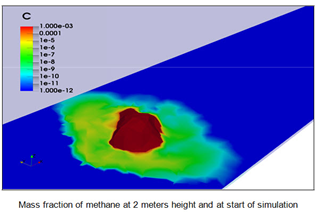
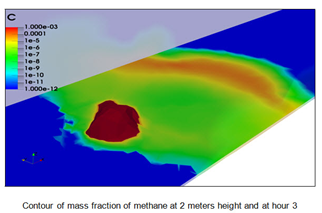
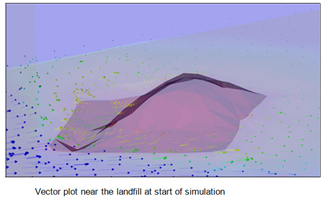
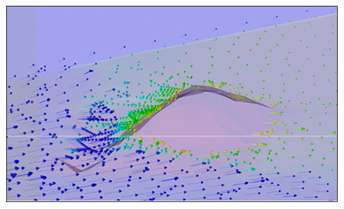
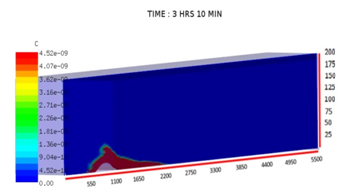
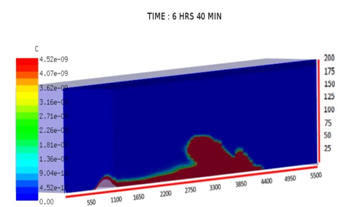
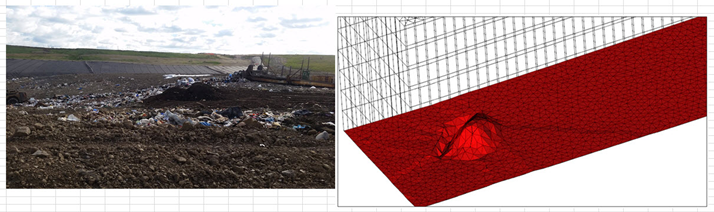
Advanced CFD (computational fluid dynamics) model was used to determine the movement of methane and odors at a landfill. The model is based on Reynolds averaged 3-dimensional Navier-Stokes equations that explicitly accounts for spatial changes in winds around the landfill and differences in gas density. The analysis provided an accurate portrayal of the movement of odors and methane from a Class 1 landfill (accepts municipal solid waste). The model explicitly accounts of density differences between and the methane and the complex topography that exists at a landfill. Use the model to determine the wind flow around the landfill and the dispersion of LFG and odors.
FINDINGS
The results of the analysis demonstrate the complexity of the movement of landfill gas and odors. The spatial and temporal resolution provided by CFD modeling can be used to design an odor control system.