CHALLENGE
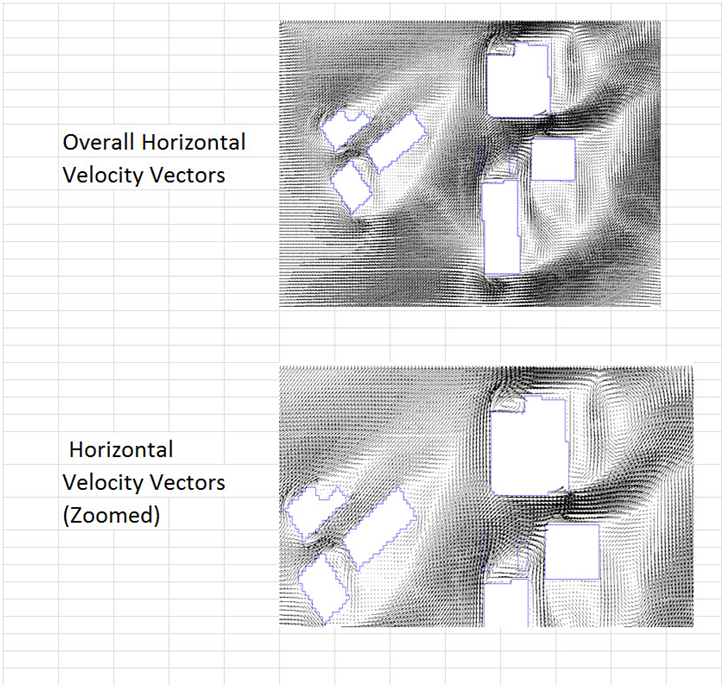
Evaluate the movement of fugitive dust from a soil blending facility in Central California. The soil blending process involves screening, blending and material handling that may generate fugitive dust. The release of fugitive dust in the presence of buildings creates localized wind patterns that differ from the overall ambient wind. Standard (Gaussian) models cannot simulate the complex wind and concentration patterns at occurred at this site. Therefore, the challenge is to determine the localized velocity vectors and dust concentration.
APPROACH
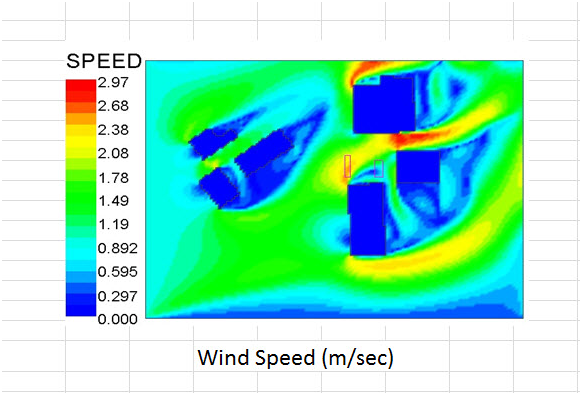
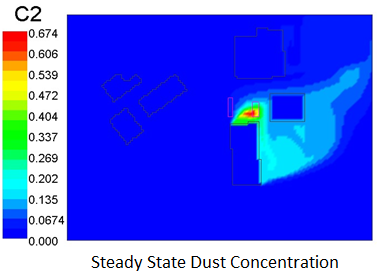
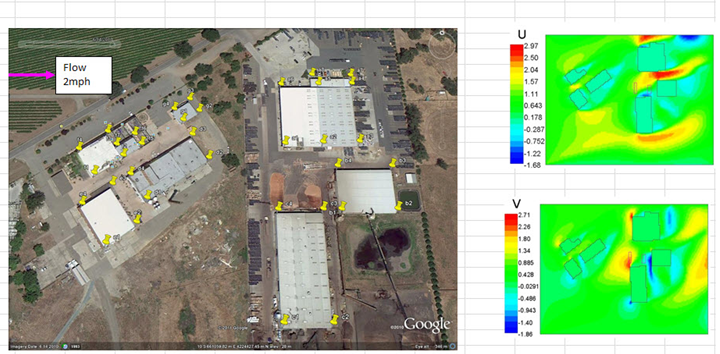
A digitized site map was created that included the soil blending operation, buildings, warehouses and nearby homes. A 3-dimensional fine grid (1 meter spacing) was created to calculate velocity vectors. ACRi’s ANSWER CFD model was used in the transient mode to develop the velocity vectors throughout the modeling domain. The emission rates of dust were calculated using empirical model recommended by the EPA (AP-42). The resulting velocity and dust concentrations were graphically presented to demonstrate the dynamic nature of the complex wind and concentrations patterns.
FINDINGS
The results of the analysis demonstrate how the presence of building dramatically alters the ambient wind. Not only did the buildings increase the wind speed by 150+% due to the venture effect, but also the predominant directions shifted 180°towards the North. High concentrations of dust were being transported towards the North even though the prevailing wind was toward the East. The results of the analysis were used to develop mitigation strategies to minimize off-site migration of fugitive.